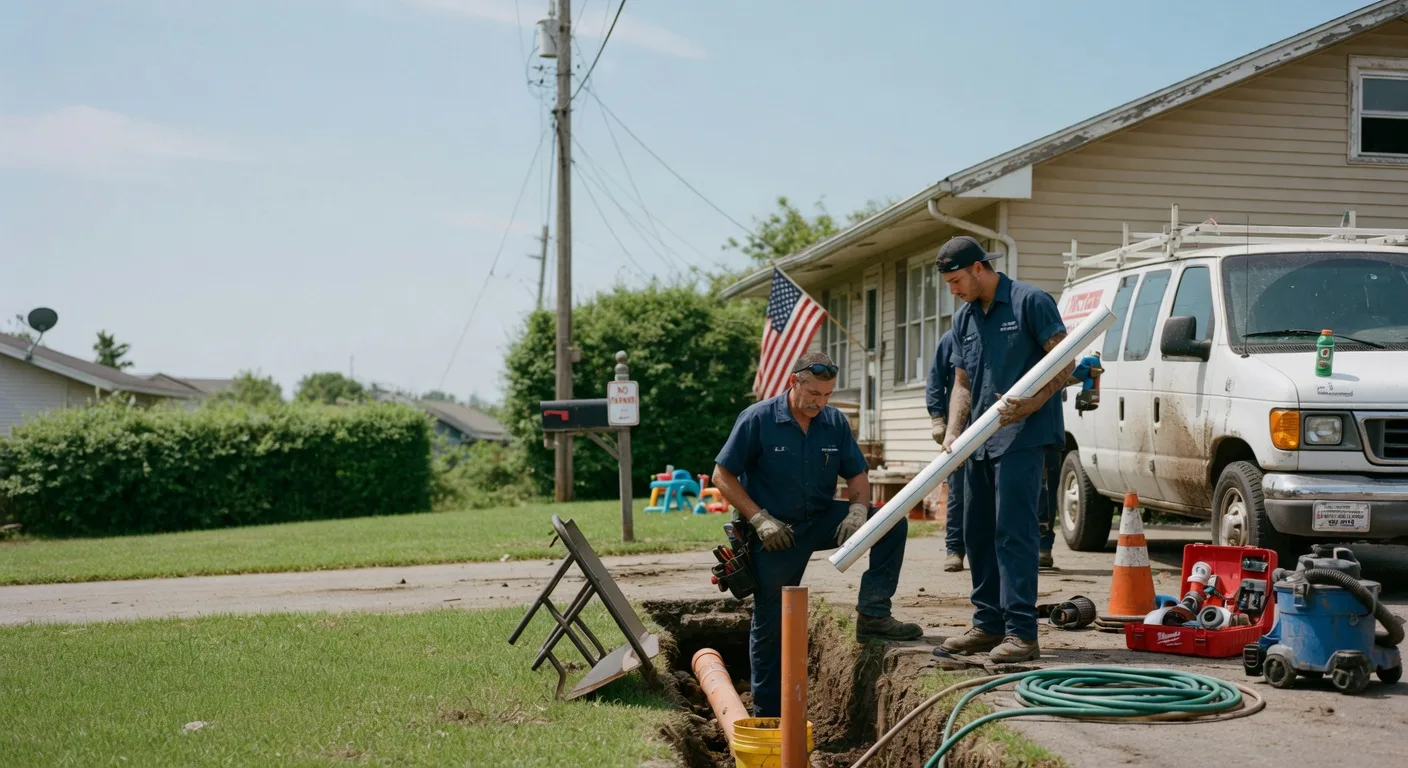
What is trenchless sewer repair and when is it an option?
You have been told the sewer line may need replacing, and you want to know if that means digging it all up. Trenchless repair avoids that. The plumber works from one or two small access pits, or from an existing cleanout, and either lines the old pipe from the inside or pulls a new pipe through the old path.
It is an option when the line is cracked, offset at a joint, or split by root intrusion at a clay joint, but still runs as one continuous pipe. Cast iron choked with scale can sometimes be lined too, after the scale is cleared. That usually means hydro jetting first, then a camera inspection to confirm the pipe condition.
It is not an option when the pipe has collapsed, when a bellied line holds water and the slope has to be corrected, or when sections are crushed or missing. A liner follows the old path, so a sag stays a sag. Those jobs need open excavation.
The camera inspection decides it. If the main line clogs again after every Drain Cleaning visit, the pipe may be failing, not just dirty.
Cost depends on how deep and how long the line is, how many access points are needed, the materials used, how much has to be opened up or removed above it, and any permit or code requirement. Expert Plumbers Co is a referral service, not a plumbing contractor. Call (380) 262-9173 and we will refer you to a plumber serving Eastport, ME who can inspect the line.
Before any lining starts, ask the plumber to confirm where every side connection joins the main. Branches such as a second bathroom or a laundry line have to be reopened from the inside once the liner sets, and the camera run afterwards should show each one open. Tell the plumber about earlier backups, the age of the house and any past repairs, because older homes often have clay, cast iron and fiber pipe in the same run, and the liner has to bond to each. The finished pipe is slightly narrower inside, but its surface is smooth, so flow usually improves. Plan around laundry and showers while the liner cures, since the line cannot be used until it has set. Ask for the recording of the finished pipe and keep it with your house papers. It helps if you sell the home, and it shows the next plumber exactly what was installed and where it runs.
What is a sewer lateral and who is responsible for repairing it?
A sewer lateral is the pipe that carries waste from your house to the main sewer line. You usually hear the term when a camera shows a crack, or when every drain in the house backs up at once.
It starts where your drain lines leave the building and runs underground to the connection with the main. Older laterals are often clay, cast iron or fibre pipe, and they fail in familiar ways. Roots work into a clay joint. The pipe sags into a belly that holds water. A section cracks or collapses. Scale narrows cast iron until little gets through.
Who repairs it depends on where the fault is and on local rules. In many places the owner is responsible for the lateral up to the property line, and sometimes all the way to the main. In others the utility owns the part under the street. Your city or sewer utility can tell you where responsibility sits for your address in Eastport, ME. Ask before you assume.
Safe homeowner check: note which drains are slow, and whether it is one fixture or all of them. Stop running water and call now if every drain is backing up, or if sewage is coming up in a tub or floor drain.
A camera inspection finds the break. Cost depends on depth, access, how much must be dug or opened, the materials, and any permit. Expert Plumbers Co is a referral service. Call (380) 262-9173 and we will connect you with a plumber in Eastport, ME.
Ask the plumber whether the camera run can note the distance from the cleanout to the fault, so you can tell which part of the lateral is the problem. A fault near the house, a fault at the property line and a fault under the street can each land with a different owner. Before any repair, take a screenshot or copy of the footage and keep a note of the date. Local rules may require a permit, an inspection by the building department or the utility, or notice to the sewer authority, so check before digging starts. Some utilities or cities also run programs that cover part of a lateral repair, and a few require an inspection when a property is sold. Ask your homeowner policy provider what it says about sewer line damage, because many standard policies leave it out. Older neighborhoods with mature trees tend to have more root problems, so it is worth asking about a root-resistant joint when the pipe is renewed.
The laundry sink in my basement fills up when someone uses the drains upstairs. Why?
A basement laundry sink is often one of the lowest open drains in the house. When it fills with water from upstairs, that water is coming back up the main drain because the line below is blocked or too slow to carry it away.
Everything upstairs drains down through a vertical stack and into the main line that leaves the house. If that main line is partly blocked by roots at a clay joint, a bellied section holding water, or grease and wipes that have built up, the flow stops short and rises to the lowest point. That is the basement.
Check whether the floor drain, a basement toilet or a shower shows the same thing. If the laundry sink fills when you flush an upstairs toilet or run the washing machine, the main drain is the likely cause. If it only happens with the dishwasher or one bathroom, the blockage may be on a branch line instead.
Safe checks you can do: stop running water in the house for an hour and see whether the level drops. Find the cleanout, a capped pipe near the floor or outside wall, and note where it is for the plumber, but do not open it while the line is full. Do not run the washing machine or take showers to test it, and do not use chemical cleaner.
Stop all water use and call now if the water in the sink is dirty or smells, if it is rising, or if it spills over the rim. Sewage in a basement is a health hazard, so keep people and pets away and do not touch it without gloves.
A cable machine can clear a soft blockage in the main line from the cleanout. If it returns, or if the cable stops at the same spot, a camera inspection shows whether roots, a bellied pipe or a failed sewer lateral is behind it. Hydro jetting clears grease and roots more thoroughly than a cable, and a damaged line may need a repair or replacement section.
Cost depends on access to the cleanout, how far the blockage sits, whether roots or a collapsed pipe are involved, and how much has to be dug or opened.
Expert Plumbers Co can connect you with an independent local plumber in Eastport, ME when you call (380) 262-9173.
The outdoor drain by my driveway, patio or basement stairwell floods in heavy rain. Who clears that?
"The drain by my driveway floods every time it rains hard." Outdoor drains at driveways, patios and basement stairwells fail in heavy rain because they are built to move a lot of water quickly, and leaves, silt and gravel stop that. The grate clogs, then the pipe below fills.
The first thing to know is where it goes. Many exterior area drains tie into a storm line or a dry well, not the sanitary sewer. Some connect to the house drain, and rules vary by area on whether that is allowed. Where the pipe ends decides who can service it, what tools make sense and whether a permit is involved.
Common causes are packed leaves and silt in the drain body, a pipe crushed or shifted by a root or vehicle, tree roots entering a joint, a pipe with too little fall so it holds water, and a storm line that is full or backed up downstream. In a stairwell, the pipe often runs to a lower point and can clog with mud.
If one outdoor drain floods and the rest of the house drains normally, the blockage is in that outdoor branch. If basement floor drains and toilets back up in the same storm, the drain may be tied to the house drain or the main line is overloaded. Check which, because that changes the repair.
Safe homeowner check: Take the grate off and clear leaves and debris by hand with gloves. Look into the drain with a light. Pour a bucket of water in and watch if it drains or stands. Note whether the problem happens only in heavy rain. Do not stand in standing water near electric outlets, and do not poke the pipe with a rod that could crack it.
Stop running water and call now if water is entering the house through a door or foundation, a basement drain is rising, sewage smell comes with the flooding, or the water backs up into indoor fixtures.
A cable machine can clear soft debris and some roots. Hydro jetting is better for packed silt and fine roots in a longer run. A camera inspection helps when the drain keeps flooding, because it shows a collapsed section, a belly holding water, or where the line actually discharges.
Expert Plumbers Co is a referral service. We connect you with an independent local plumber in Eastport, ME. Call (380) 262-9173.
Ask the plumber where the drain discharges and whether it can be reached with a cleanout. Ask whether a repair or regrading is needed, not just clearing. Cost depends on access, the parts or materials needed, how much of the paving or soil has to be opened up or removed, and any permit or code requirement.
We live in a manufactured home. Why do the drains under the floor keep clogging?
You live in a manufactured home, and the drains keep clogging. A sink runs slow, the tub gurgles, or the toilet backs up every few months. The cause is usually under the floor, where you cannot see it.
Drain lines in a manufactured home run through the belly wrap, between the floor framing and the ground. The runs are long and shallow, with very little fall, so water and solids move slowly and grease, soap and paper settle. Over time the hangers that hold the pipe can fail and the line sags. A sagging section becomes a bellied line that holds water and collects debris. Lightweight plastic pipe can also crack or pull apart at joints when the ground shifts.
Cold weather adds a problem. Pipes under the floor can freeze, and a frozen drain looks like a clog until it thaws. Roots can also reach the outside section where the home ties into the sewer.
One slow fixture is usually a branch or trap problem near that fixture. If sinks, tub, toilet and washer all slow down together, or water comes up in the lowest fixture, the main run under the home or the sewer connection is the likely spot.
Safe homeowner check: Run each fixture one at a time and note which are slow. Look for a cleanout outside near the home and see whether it holds water, without opening it under pressure. Do not crawl under the home if it is wet or smells of sewage.
Stop running water and call now if sewage is coming up inside, if water drips from the belly wrap, if the floor feels soft, or if the smell of sewage is strong under or around the home.
A cable machine is often enough for a soft clog in one branch. Hydro jetting is the better tool for build-up on the wall of a long, shallow run. A camera inspection is the right step when clogs keep returning, because it can show a sag, a cracked joint or a separated pipe.
Expert Plumbers Co is a referral service. We connect you with an independent local plumber in Eastport, ME. Call (380) 262-9173.
Ask the plumber how they will reach the pipe and whether the belly wrap has to be opened and resealed. The scope depends on access under the home, how much belly board or insulation comes off, the pipe material, whether hangers need replacing to restore the slope, and any permit or code requirement.